If you use multiple AI coding agents—OpenCode, VS Code, Codex, or Custom GPTs—you have probably noticed something frustrating: every tool seems to need a different config format. Your MCP setup does not work for OpenAPI Actions, and your VS Code config does not transfer to other runtimes.
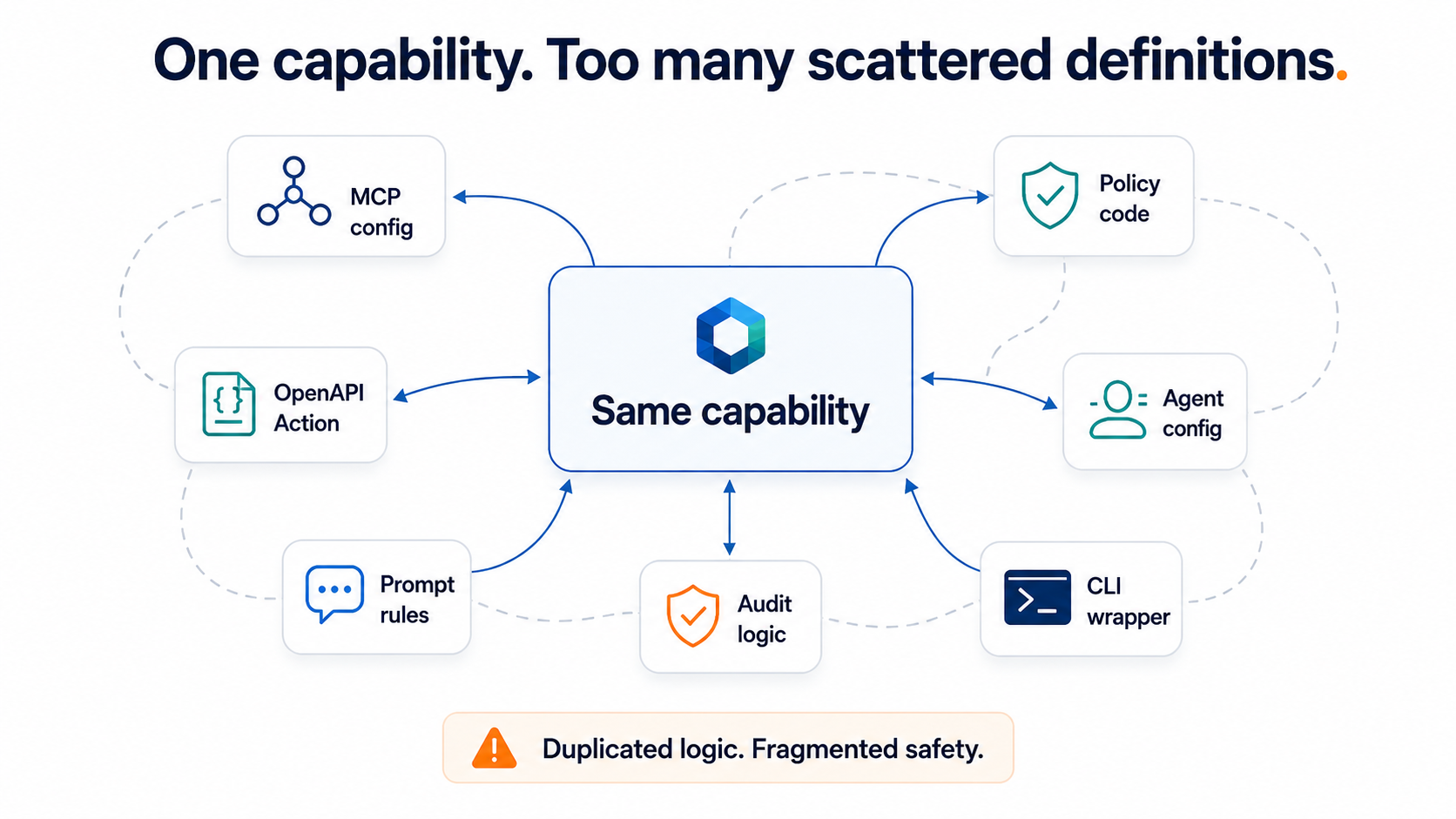
Every AI coding agent has its own configuration shape. Some use MCP JSON, some use TOML, some use workspace files and some use commands or skill folders. MCP standardizes part of the tool protocol, but it does not make every client configuration identical.
That creates a maintenance problem for teams that want the same safe action across multiple agent runtimes.
The config drift problem
.vscode/mcp.jsonopencode.json.codex/config.tomlAGENTS.md- OpenAPI Actions
- gateway policy files
Capability-first generation
Actlane uses the capability manifest as the source of truth and generates target-specific files.
actlane generate vscode
actlane generate opencode
actlane generate mcp
actlane generate openapi
Why this is safer than copy-paste
When policy changes, generated artifacts can be regenerated. Contract tests can verify that all targets still expose the same action with the same schema and restrictions.
Brownfield adoption
Actlane should not overwrite existing project files by default. It can generate into .actlane/generated, show diffs and apply only when explicitly requested.
Recommended rollout
- Inspect current agent configs.
- Create one capability manifest.
- Generate artifacts into an overlay directory.
- Review diffs.
- Apply only selected integrations.
Why this topic is related to Actlane
This is the core Actlane workflow: define one capability and generate the surrounding MCP tools, OpenAPI Actions, agent instructions, IDE configs and policy bundles instead of copy-pasting the same rules across runtimes.
Try Actlane
Actlane is a DSL-first toolkit for safe AI-agent actions. Define a capability once, and it generates MCP tools, OpenAPI Actions, IDE configs and policy bundles—all from a single source of truth.
Explore on GitHub · See the safe draft PR example · Back to all articles